How to Create a Coastal Home That Feels Effortlessly Elegant
 There is a particular kind of coastal home that never seems to go out of style.
It is light without feeling stark. Relaxed without being casual. Beautiful without looking as though anyone has tried too hard.
It doesn’t need anchors on the wall, bowls of seashells or everything upholstered in blue and white. In fact, the most beautiful coastal homes often have surprisingly little that could be described as “coastal décor” at all.
What they have instead is a feeling.
Light. Air. Natural materials. Space around things. Curtains that move when the windows are open. Objects that have been collected rather than coordinated. A quiet connection to the landscape outside.
The best coastal rooms don’t announce that they are coastal. They simply feel as though the sea isn’t very far away.
Start with light and air
Before thinking about what to put into a room, think about what you can leave out.
Coastal interiors need room to breathe. That doesn’t necessarily mean enormous rooms or high ceilings. A small room can feel wonderfully open when it isn’t crowded with furniture and every wall isn’t asking for attention.
Let the windows do some of the work.
Soft linen curtains are particularly beautiful because they filter rather than block the light. Hung generously, they bring softness and movement to a room and change throughout the day as the light changes.
And resist the urge to fill every empty corner.
Negative space is part of the design.
White doesn’t have to feel cold
A white room can feel clinical when everything around it is equally hard, bright and perfect.
Put that same white beside warm timber, washed linen, woven baskets, an old wooden table, natural stone and handmade ceramics, and something quite different happens.
The white becomes a backdrop.
It reflects the light and gives the more tactile things in the room room to be noticed.
That is one of the secrets of an elegant coastal interior: the palette can be restrained without the room feeling sterile.
Take your colours from nature, not from a decorating rule
Blue belongs beautifully in a coastal home, but it doesn’t have to be everywhere.
Look beyond the obvious colours of the sea.
Think of sand, driftwood, weathered grey, chalk, sea grass, shells, stone and the almost-black colour of wet rocks. Think of the faded colours of things that have spent years in the sun.
A room built around these softer colours has space for something unexpected.
And sometimes that unexpected thing is what makes the room.

Choose character over perfection
A beautiful home needs evidence of life.
An old chair with a slightly worn arm. A pile of books. A handmade bowl that isn’t quite symmetrical. A piece brought home from a journey. Something inherited. Something found.
These are the things that stop a carefully decorated room from looking like a showroom.
They also give the eye somewhere to pause.
There is a wonderful simplicity in a glass bowl filled with smooth white pebbles — and then one dark pebble amongst them. The dark one doesn’t spoil the arrangement. It makes you notice it.
Perfection rarely needs more perfection.
Sometimes it needs interruption.
Bring nature inside without turning it into a theme
There is a difference between being inspired by the coast and decorating a room to prove that you live near it.
You don’t need a collection of shells to establish a relationship with the sea.
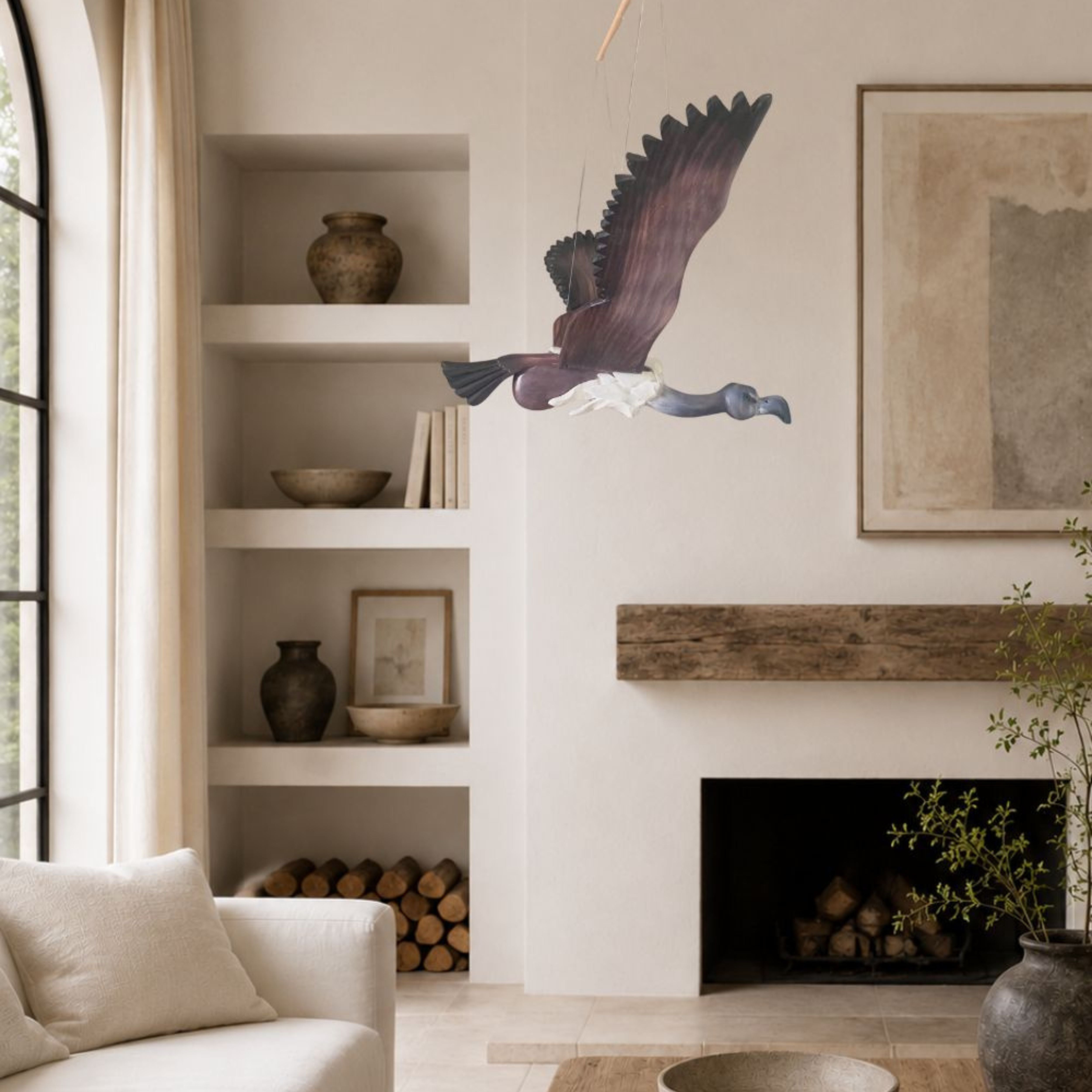
A branch in a large glass vase, a beautiful piece of weathered wood, a woven chair or a bird suspended quietly above a favourite reading spot can create that connection far more naturally.
Birds are particularly evocative in coastal spaces because they belong to the landscape.
A hand-carved Seagull immediately recalls open skies and the edge of the water. A Swan feels quieter and more graceful. A Crane brings a long, sculptural silhouette to a contemporary room.
And then there is the Flamingo.
Allow one thing to surprise you
A coastal room doesn’t have to be entirely quiet.
In fact, restraint makes an unexpected object much more powerful.
Imagine a room of white linen, pale timber and natural textures, sunlight coming through long curtains — and, above it, a hand-carved Flamingo.
The pink doesn’t need to be repeated in cushions or picked up in a rug. It doesn’t need to “match”.
It can simply be there.
Like the dark pebble amongst the white ones, its difference is precisely what gives it presence.
Our WoodWings birds are individually carved and balanced by hand, so they are never completely static. A passing current of air is enough to set them gently moving.
In a coastal room, where open windows, moving curtains and changing light are already part of the atmosphere, that movement feels especially at home.
Let things move
Perhaps this is the part of coastal decorating that is easiest to overlook.
A room isn’t a photograph.
Curtains lift in the breeze. Shadows move across the floor. Leaves turn towards the window. A suspended bird changes position almost imperceptibly.
These small movements make a room feel alive.
Rather than controlling every detail, leave a little space for the house to change during the day.
Make it personal
The most memorable coastal homes aren’t memorable because they followed the rules particularly well.
They are memorable because they feel unmistakably inhabited.
So choose fewer things, and choose them carefully.
Use natural materials that become more beautiful with age. Let a little imperfection remain. Leave space around the things you love. Bring something of the landscape indoors without reproducing it literally.
And when everything feels perhaps a little too perfectly coordinated, add the black pebble.
Or, perhaps, a Flamingo.