How to Create an Eclectic Home That Feels Collected, Not Cluttered
 Walk into a truly good eclectic living room and you notice it almost immediately: nothing feels as though it arrived all at once.
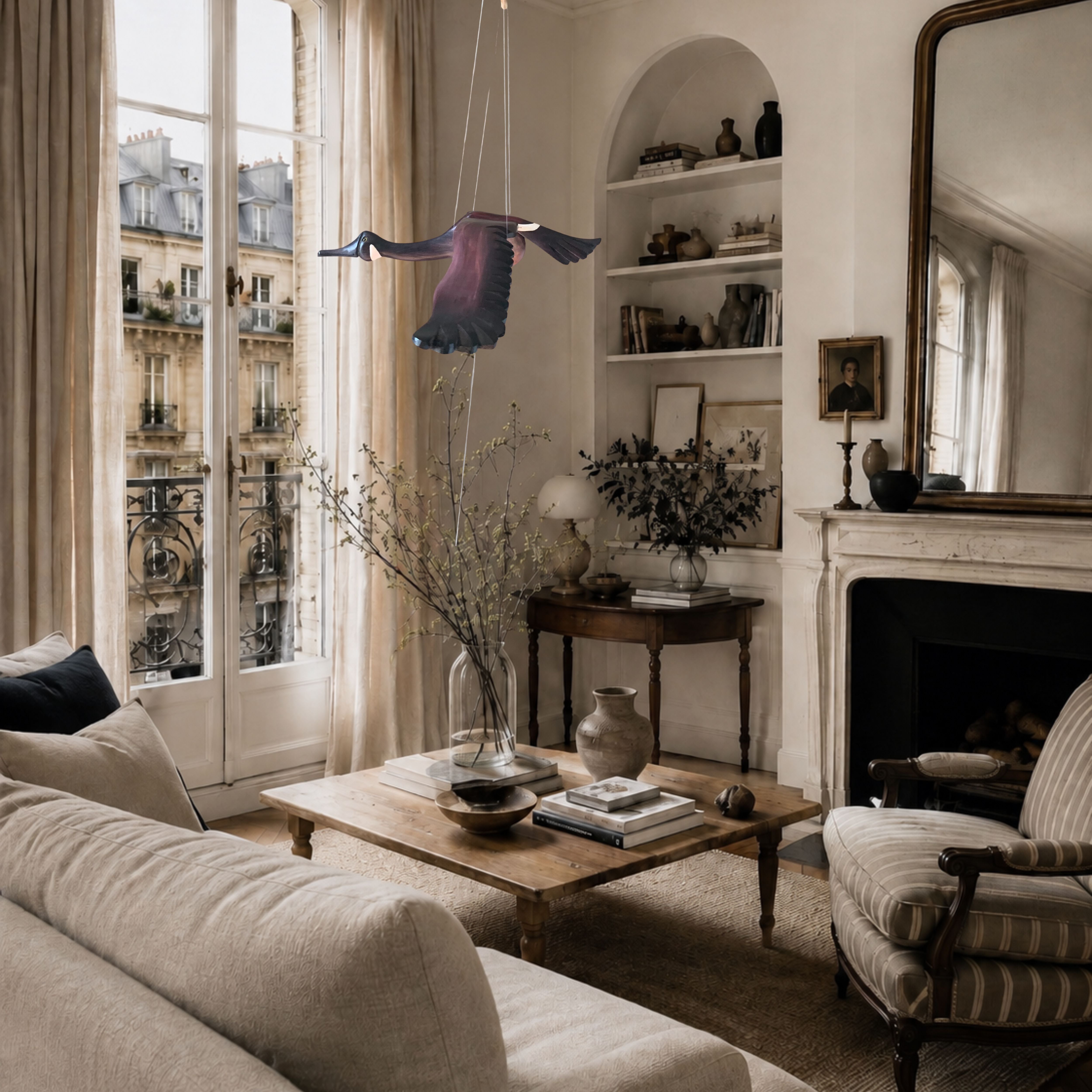
A chair with some age to it sits beside something clearly contemporary. Books look read rather than arranged. A handmade object catches the light differently from the polished things around it. There may be a beautiful old table, a modern lamp, a piece of art that means something to the owner, and perhaps something slightly unexpected suspended above it all.
The room does not feel decorated so much as accumulated.
And that, really, is the difference between an eclectic home and a cluttered one.
Eclectic home decor is not about filling every surface or rejecting restraint. The best rooms are often surprisingly disciplined. They simply follow a different set of rules. Instead of matching everything, they create relationships between things: old and new, rough and refined, useful and decorative, still and moving.
The result is a home with character — one that looks lived in rather than styled for a photograph.
Choose character over perfection
A room becomes far more interesting when everything has not come from the same shop or collection.
There is nothing inherently wrong with new furniture, or even with pieces bought together. But when every object speaks in exactly the same voice, the room can begin to feel anonymous.
An eclectic room benefits from a little friction.
A contemporary sofa beside an old wooden table. A simple linen curtain near a sculptural ceramic lamp. A clean white wall softened by timber, books and something handmade. Suddenly that white wall no longer feels cold or sterile. It becomes a quiet backdrop for the things that matter.
This is where imperfection becomes useful too.
Handmade objects bring evidence of the person who made them: variations in grain, small differences in shape, a glaze that does not repeat exactly, the marks left by carving or painting.
Those details give a room life.
Let old and new argue a little
Contrast does a great deal of the work in eclectic interiors.
An antique surrounded only by antiques can almost disappear. Place it beside something distinctly modern and you begin to notice its proportions, patina and history again.
The reverse is also true. A very modern object often feels warmer and less showroom-like when it sits beside something older.
The aim is not to make opposites clash for effect. It is simply to let different periods and materials sharpen one another.
A worn leather chair beside a clean-lined shelf. A contemporary pendant light above an old table. A hand-carved wooden object against a plain wall.
Neither piece needs to imitate the other.
Give the room a centre of gravity
Every eclectic room benefits from one or two things that quietly hold everything together.
Not necessarily the largest things. Not necessarily the most expensive.
Often it is simply the most unusual object in the room.
This is one of the reasons we love living with our wooden bird mobiles.
A hand-carved bird suspended in a room behaves very differently from an object placed on a shelf. It occupies the space above the furniture. It casts shifting shadows. It moves gently when the air changes. It can be seen from several angles, and because each bird is carved and balanced individually, it carries the slight variations that make handmade work feel alive.
In an eclectic living room, that movement can become a kind of punctuation.
A Grey Goose above a reading chair can soften an otherwise architectural space. A Swan suspended near a window can become part of the light and movement of the room. A Crane in a high-ceilinged entrance or above a staircase adds height and drama without introducing visual heaviness.
The bird does not have to dominate the room. In fact, it is often more effective when it doesn’t.
It becomes the thing people notice gradually — and then keep looking at.
That is very different from filling a room with decorative objects simply because there is space for them.

Find the thread
An eclectic room still needs coherence.
The pieces do not need to match, but something should quietly connect them.
Natural materials are particularly good at doing this. Timber, linen, leather, ceramics and metal can belong to very different periods and still sit comfortably together.
Colour can do the same thing.
A muted blue in a painting might reappear in a cushion. A warm brown in leather might echo the tone of a wooden table. A pale bird suspended above the room might pick up the colour of linen curtains or a plaster wall.
These repetitions do not need to be obvious.
Often the best rooms feel coherent before you can explain why.
Leave some things alone
Negative space matters just as much in an eclectic home as the objects themselves.
A beautiful object needs somewhere to breathe.
A bird mobile hanging against a quiet wall, for example, has far more presence than it would if surrounded by shelves, frames and competing ornaments.
The same is true of furniture and art.
Let one wall remain relatively simple. Allow a shelf to hold three meaningful objects rather than twelve. Give a chair enough room around it to feel intentional.
Eclectic does not mean every part of the room has to be doing something.
Sometimes the quiet area is what allows the interesting parts to be seen.
Use movement as part of the room
Most decorating advice concentrates on colour, texture, proportion and shape.
Movement is discussed far less often.
Yet even very subtle movement can change the feeling of a room.
Curtains shifting at an open window. Leaves moving outside. A flame. Shadows travelling across a wall during the day.
A suspended wooden bird belongs to that same category.
Because the birds are balanced to respond to gentle air currents, they are never quite static. Their wings move slowly and naturally, creating changing silhouettes and shadows across the room.
In a home filled with solid furniture and fixed objects, that small amount of movement can make the space feel unusually calm.
It is one of the reasons they work so well in rooms that already contain a mixture of old and new. They add another layer without adding another piece of furniture or another object to a surface.
Choose objects with a story
The most memorable things in an eclectic room are rarely the ones chosen because they matched the colour scheme.
They are the things that have a reason for being there.
Something inherited. Something found while travelling. Something made by a friend. A piece of art bought because you simply could not stop thinking about it.
Or something handmade whose story begins before it ever reaches your home.
Our birds begin as timber in a Johannesburg workshop, where Dominic carves them by hand before each one is painted, assembled and carefully balanced. There are no moulds producing identical birds. The differences between them are part of what you are buying.
That matters in an eclectic interior because the room itself is built from differences.
Objects made by different hands, at different times, for different reasons.
And somehow, when they are chosen well, they begin to belong together.
A home needs evidence of life
Perhaps the biggest mistake in decorating is trying too hard to finish a room.
The most appealing homes rarely feel finished.
There is a book left on a chair. Something collected years ago sits beside something bought last month. A favourite object moves when someone opens a door. The light changes. The shadows move.
The room continues to evolve because the people living in it continue to evolve.
That is what makes eclectic interiors so forgiving.
You do not need to find everything now.
You only need to keep choosing things that deserve to stay.
A collected home grows slowly. It develops its own rhythm, its own contradictions and its own centre of gravity.
And when it works, it feels cohesive not because everything matches, but because everything in it has earned its place.