How to Make a Living Room Feel Cozy Without Making It Cluttered

A cozy living room is not necessarily a full one.
It does not need every wall covered, every shelf filled or every chair surrounded by baskets, blankets and decorative objects. In fact, some of the most inviting rooms are relatively restrained. They simply know where warmth comes from.
Usually, it is not the number of things in the room. It is the way light falls across the furniture. The feel of linen, timber, wool and leather. A lamp switched on before the room is completely dark. Books that are actually read. One or two objects that carry a story. Something handmade that catches your eye without demanding it.
The aim is not emptiness, and it is not perfection. It is to create a living room that feels comfortable, personal and layered, while still giving everything enough room to breathe.
Begin with light, not objects
When a room feels cold, the instinct is often to add more things.
Another cushion. Another plant. Another framed print. Something for the coffee table. Something for the empty corner.
But before adding anything, look at the lighting.
A single bright ceiling light can make even a beautifully furnished room feel flat and exposed. Cozy living rooms tend to have several gentler sources of light at different heights: a floor lamp beside a chair, a table lamp on a cabinet, perhaps a small reading light near the sofa.
The purpose is not simply to make the room brighter. It is to create pockets of light.
A lamp illuminating one corner makes that corner feel inviting. Light falling across books, ceramics or timber draws attention to their texture. The darker spaces between those areas give the room depth.
Natural light matters too. Sheer linen curtains can soften a hard window without blocking daylight. A mirror placed thoughtfully can reflect light into a darker part of the room. Even the direction of a chair can make a difference: turned slightly toward a window, it immediately feels more like a place where someone might want to sit.
Use texture to create warmth
Colour helps create atmosphere, but texture often does more.
A neutral room can still feel deeply cozy when it contains materials that invite touch: washed linen, wool, timber, leather, woven fibres, handmade ceramics and softly worn rugs.
The key is layering, but not piling.
A sofa might need one good throw rather than three. A chair may need a single patterned cushion. A plain floor can be softened by a rug with some age or variation in its surface. Curtains can bring softness to a room without taking up any physical space.
Natural materials are especially useful because they tend to sit comfortably beside one another. Timber does not need to match perfectly with other timber. A smooth ceramic bowl can work beside a rougher clay vessel. Linen can sit beside leather without either one feeling out of place.
These differences give the room life.
Give the room one clear place to settle
A cozy living room needs a centre of gravity.
That might be a fireplace, a coffee table, a reading chair, a piece of art or simply the arrangement of the seating. Without one, the room can feel as though everything is floating independently.
The centre does not need to be dramatic. It simply needs to help the eye understand the room.
A coffee table can do this when it is positioned naturally between the seating and given a few carefully chosen objects: a small stack of books, a bowl, perhaps flowers or a branch in a vase. A reading chair can become a focal point when it has good light, a side table and enough space around it.
What matters is that not every object competes for equal attention.
If the sofa, rug, artwork, lamp, shelves and coffee table are all demanding to be noticed at once, the room begins to feel restless. Choose one or two areas to carry more visual weight, and allow the rest to support them quietly.
Leave some surfaces unfinished
An empty surface is not a failure.
A shelf does not need to be filled from end to end. A coffee table does not need a perfectly arranged collection of objects. A wall can remain mostly clear.
This is often the difference between a room that feels layered and one that feels cluttered.
Negative space allows individual objects to register. A beautiful bowl becomes more noticeable when it is not surrounded by six smaller objects. A piece of art has more impact when it is not squeezed into a crowded gallery wall. A handmade object feels more important when it has a little breathing room around it.
Try removing one thing before adding another.
If a shelf feels busy, take away the object you like least. If the coffee table feels overworked, keep only the books and one bowl. If a corner already contains a chair, a lamp and a plant, it may not need anything else.
Cozy does not mean crowded. It means considered.
Choose objects that feel personal
A room becomes warm when it contains evidence of a life.
Not staged evidence. Real evidence.
Books that have been opened. Ceramics chosen because you loved their shape. Something inherited. A piece brought home from a trip. A photograph that means more to you than it ever could to a visitor.
These objects do not need to match. Their connection comes from the fact that you chose to keep them.
That is why personal rooms often feel more comfortable than perfectly coordinated ones. Matching is easy to recognise, but familiarity is what makes a room feel like home.
It also means that you do not need to buy everything at once. A living room can develop slowly. In fact, it usually feels better when it does.
Add movement without adding clutter
Most living rooms are made almost entirely from static objects.
The sofa stays still. The table stays still. The shelves and lamps remain exactly where they were placed. Introducing even a small amount of movement can make the room feel softer and more alive.
Curtains shifting at an open window can do this. So can leaves moving in the breeze, shadows travelling across a wall or a flame flickering in the evening.
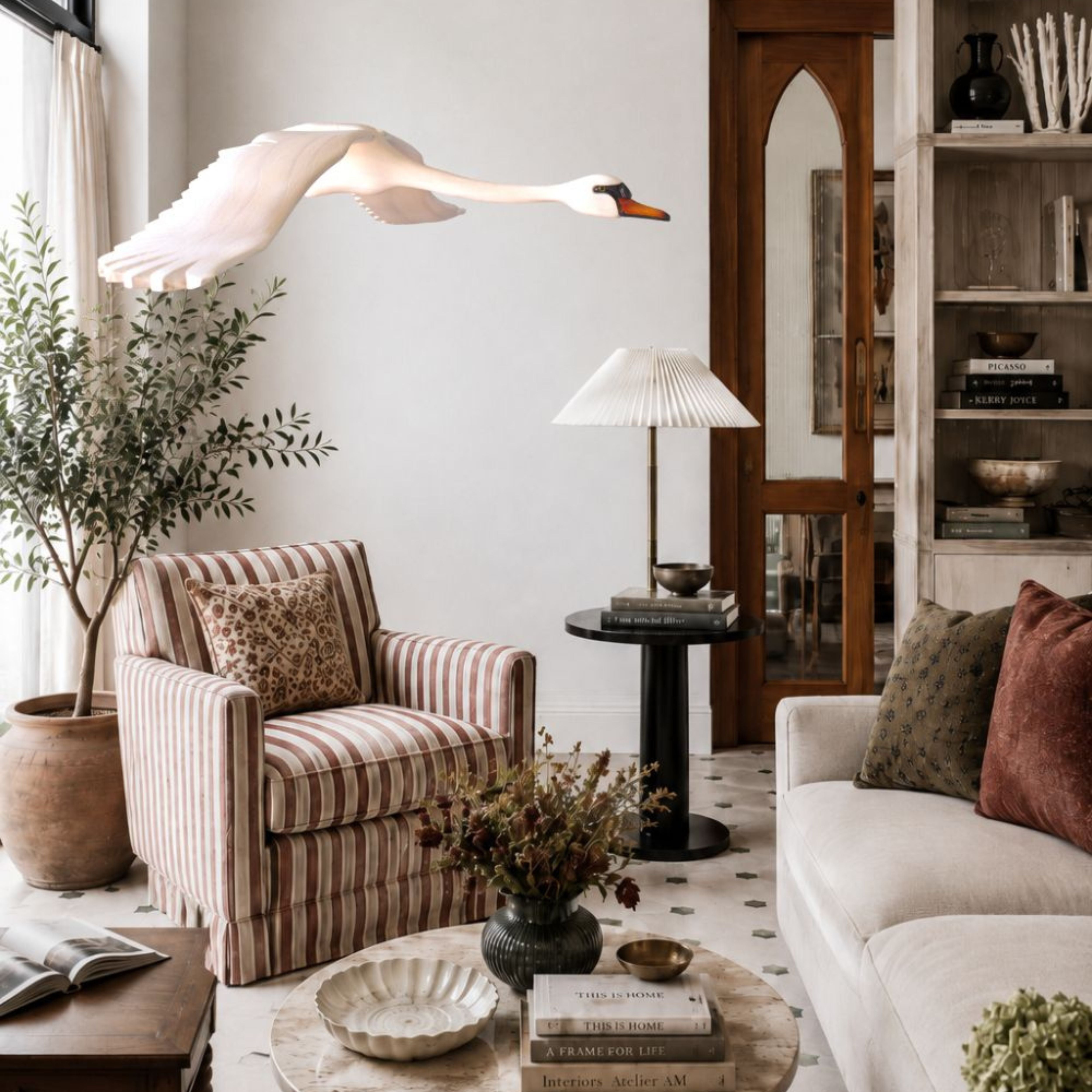
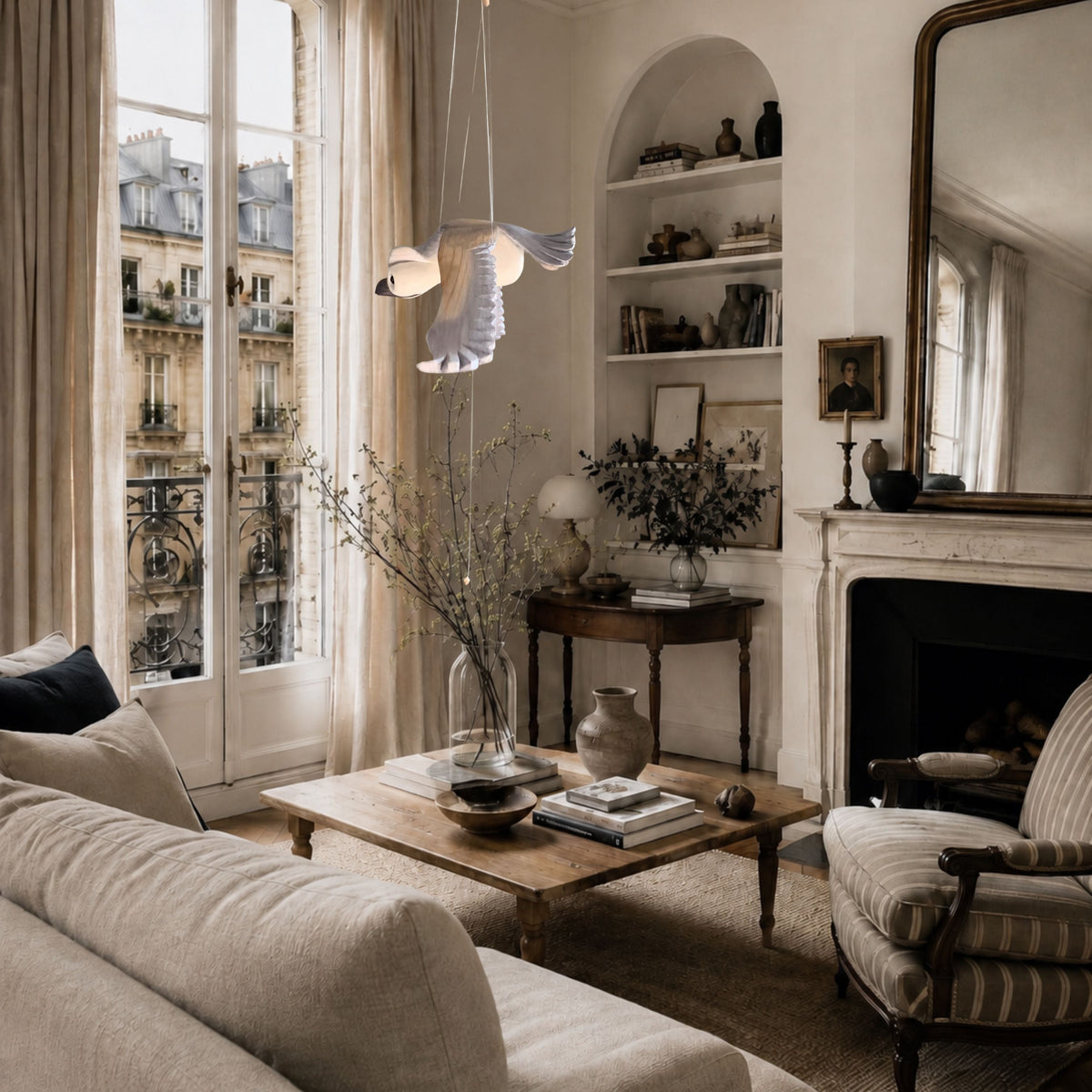
A suspended wooden bird brings that same quality into the room.
Because it occupies the air rather than a shelf or the floor, it adds presence without taking up usable space. It can become a focal point above a reading chair, beside a window or in the quiet area between two pieces of furniture.
Our birds are carved and balanced individually, so their movement is gentle rather than mechanical. Their wings respond to small changes in the air, creating shifting silhouettes and shadows across the room.
That movement is particularly effective in a living room because it contrasts with the solid weight of the furniture below it.
A pale Swan can make a neutral room feel lighter and more poetic. A Grey Goose can introduce character without disturbing a calm palette. A Hornbill or Toucan can become the unexpected note in a more collected interior, bringing personality into a room that might otherwise feel overly polite.
The important thing is not to surround the bird with too much visual competition. Give it a clear stretch of wall or open air. Let its shape and movement do the work.

Repeat a few colours quietly
A cozy room does not need a rigid colour scheme, but repetition helps it feel coherent.
Choose two or three tones that appear in different parts of the room.
A soft rust cushion might connect with a detail in the rug. Olive leaves may echo a green ceramic bowl. The warm timber of a chair can relate to the frame of a painting or the surface of a side table.
These repetitions should not feel obvious or forced. They work best when they are discovered gradually.
A room can contain many different materials and styles and still feel calm when a few colours return gently throughout it.
Do not confuse coziness with darkness
Dark rooms can feel intimate, but they are not automatically cozy. Pale rooms can feel warm too.
The deciding factor is contrast.
A dark wall may need lighter upholstery, warm timber and reflective ceramics to prevent it feeling heavy. A light room may need deeper accents—perhaps a dark table, a patterned chair or an earthy rug—to keep it from feeling washed out.
Cozy interiors tend to contain both softness and structure.
Too many pale, similar surfaces can feel bland. Too many dark, heavy pieces can feel oppressive. A balance of light and dark gives the room dimension.
Let the room remain slightly unfinished
The most inviting living rooms rarely look completely finished.
There may be space for another book, another piece of art or something not yet found. The room feels as though it can continue to change.
That openness matters.
A home should be able to absorb new parts of your life without requiring a complete redesign. Something bought years from now should still have somewhere to belong.
The goal is not to produce a final arrangement that can never be disturbed. It is to create a room with enough clarity and breathing space to evolve.
A cozy room is one that invites you to stay
Ultimately, coziness is less about appearance than behaviour.
Does the room make you want to sit down? Is there somewhere comfortable to read? Is the light gentle in the evening? Can you put down a cup without first moving a pile of decorative objects?
A cozy living room supports the life taking place inside it.
It contains enough texture, light and personality to feel warm, but not so much that the room becomes tiring. It gives meaningful objects space to be noticed. It allows stillness, movement and emptiness to exist together.
And perhaps most importantly, it does not feel as though it was finished in a single afternoon.
It feels as though it has been lived with, adjusted and slowly made more comfortable over time.