Article: How to Decorate Double-Volume Rooms and Large Open Spaces
How to Decorate Double-Volume Rooms and Large Open Spaces

Double-volume rooms are spectacular. High ceilings, generous proportions and an abundance of natural light can give a home a wonderful sense of space. But they also present an unusual decorating problem: what do you do with all that empty air?
Furniture alone rarely solves it. A beautifully furnished living room can still feel strangely unfinished when everything of visual interest stops two metres above the floor and another three or four metres of space continues overhead.
The answer isn't necessarily to add more things. It's to think differently about scale, height and the space between the floor and ceiling.
Think vertically, not just horizontally
Most of us decorate at eye level. We arrange furniture, hang pictures, position lamps and style shelves. In an ordinary room, that's often enough.
In a double-volume room, however, your eye travels upwards. If nothing draws it into the upper part of the room, the space can feel disconnected — almost as though the ceiling belongs to a different room altogether.
Tall plants, oversized artwork, long pendant lights and sculptural objects can all help bridge that gap. The aim isn't to fill every empty area, but to create one or two strong visual moments that connect the lower and upper parts of the room.
Choose fewer pieces, but make them count
Large rooms can tempt us into adding more furniture and more decoration simply because there is space for it. Often, the opposite approach works better.
One substantial piece can have far more impact than a collection of smaller objects.
An oversized painting, a dramatic pendant light or a suspended sculpture gives the eye somewhere to settle while allowing the architecture around it to breathe. This is particularly effective in contemporary, minimalist and neutral interiors, where a single unexpected object can completely change the character of the room.
Scale matters here. Something that looks enormous in your hands may appear surprisingly modest once it is suspended several metres above the floor.
Don't forget the space above you
Ceilings are often treated simply as the place where the lights go. In a high-ceilinged room, they offer much more possibility.
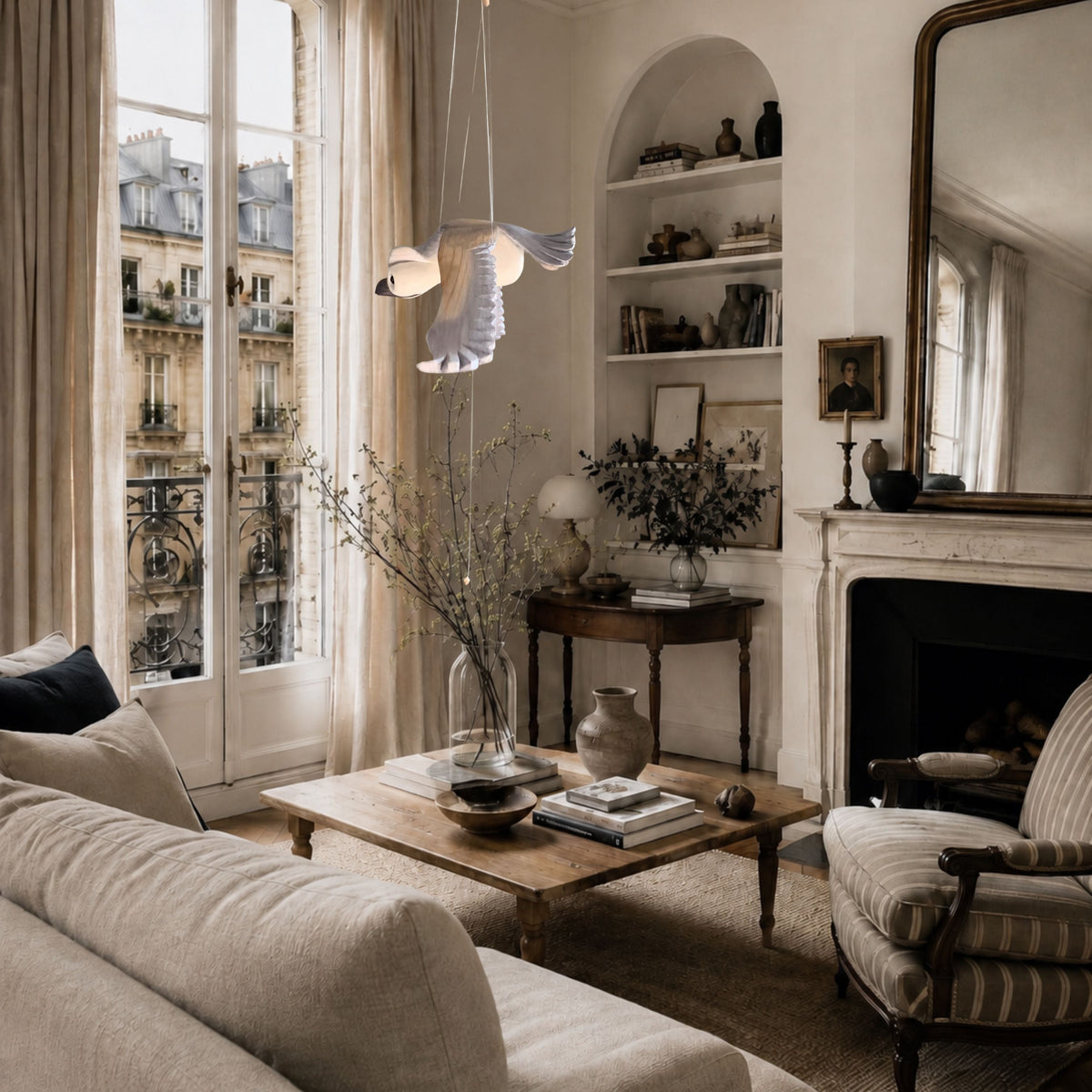
Suspended art occupies a part of the room that conventional pictures and furniture cannot reach. It can work particularly well above a stairwell, in an entrance hall, beside a mezzanine, above a dining area or in the open space between two levels of a home.
There is another advantage: suspended pieces can be appreciated from several viewpoints. You may see them from below when entering the room, at eye level from an upstairs landing, and from completely different angles as you move through the house.
That makes them especially suited to large, open-plan spaces where an object needs to be interesting from more than one direction.
Introduce movement
Large interiors often contain strong architectural lines — tall windows, long walls, exposed beams and large expanses of glass. Introducing something that moves can soften all that structure.
Kinetic art responds to the air around it. Even very gentle movement changes the relationship between an object and the room because it never looks quite the same twice.
Our hand-carved WoodWings flying birds were created with exactly this kind of movement in mind. Suspended from above, their wings can be raised and lowered, transforming a carved wooden sculpture into something that appears to be moving through the space.
The larger birds are particularly striking in double-volume rooms because they have enough room around them to be appreciated at their full scale.
Use colour as a focal point
A large room doesn't necessarily need a lot of colour.
In fact, one concentrated area of colour can be much more powerful than spreading colour throughout the room. Against white walls, natural timber, stone, linen and other neutral materials, a vivid sculptural object becomes an immediate focal point.
This is one of the reasons our Scarlet Macaw works so beautifully in restrained interiors. Its intense reds, blues and yellows need very little competition around them. The room can remain calm and sophisticated while the bird provides the moment of surprise.
Our Blue & Gold Macaw, with its turquoise blues, greens and warm golden tones, creates a different effect — still dramatic, but cooler and particularly beautiful against warm whites, timber and earthy neutrals.
Neither requires the rest of the room to become tropical. Sometimes a single extraordinary object is enough.

Work with the architecture
Before choosing something for a large space, look at where the architecture naturally directs your eye.
A staircase may create the perfect sightline for a suspended sculpture. A tall window may provide a beautiful backdrop. An empty corner beside a mezzanine might need height rather than another piece of furniture.
Consider the view from different positions too. In an open-plan home, the object you choose may be visible from the kitchen, dining room, entrance and upper floor. The best placement is often one that creates several different compositions depending on where you are standing.
And don't assume everything has to be centred. An object suspended slightly off-centre can create far more tension and interest than something positioned rigidly in the middle of a room.
Let empty space remain empty
Perhaps the most important thing when decorating a large room is knowing when to stop.
Empty space isn't wasted space. It is what allows a beautiful object to be seen.
A dramatic sculpture needs room around it. An oversized pendant needs air beneath it. A large artwork needs enough bare wall to give it importance.
Rather than asking, “How do I fill this enormous room?”, try asking:
“What is the one thing I want people to notice when they walk into it?”
That change in thinking can make decorating a difficult large space considerably easier.

A different kind of statement piece
There is something wonderful about looking upwards in a home and finding something unexpected.
A flying bird suspended overhead brings sculpture, colour, craftsmanship and movement into a part of the room that is so often left untouched. And in a double-volume space, where conventional decorative objects can easily disappear, its scale finally has somewhere to breathe.
Our WoodWings birds are individually carved and painted by hand in our Johannesburg workshop. Each one is designed as a moving wooden sculpture rather than a static ornament, with wings that rise and fall to create the impression of flight.
For large interiors, our new Scarlet Macaw and Blue & Gold Macaw are among the most dramatic birds we have ever made.
Because sometimes a big empty space doesn't need more furniture.
It just needs one unforgettable thing in exactly the right place.