How to Make a Neutral Room Interesting Without Adding More Colour

There's a particular kind of neutral room that feels calm the moment you walk in, and another that simply feels empty.
The two can look remarkably similar in a photograph, the same palette of whites, creams, beiges and soft browns, the same absence of anything bold or bright, yet one holds your attention and the other doesn't.
The difference rarely has much to do with colour at all.
It has to do with everything colour is usually asked to do in a room, create contrast, establish a focal point, introduce energy and guide the eye, and what is left to do that work once colour has been taken off the table.
A neutral room can have enormous character without introducing a single bright shade. The secret is to build interest through tone, texture, form, scale, light, shadow and movement instead.
Why neutral rooms sometimes feel flat
Colour is an easy shortcut to visual interest.
A single red chair, a richly patterned rug or a wall painted deep green announces itself immediately. Take colour away and the room has to create interest through other means.
When a neutral room feels flat, it usually isn't because it needs more colour. More often, the absence of colour has been treated as the finished decorating decision rather than the starting point for a different kind of one.
A beautifully chosen white wall, an oatmeal sofa and furniture in complementary shades of stone may create a restful space, but the eye still needs somewhere to land.
In a colourful room, colour often does that job.
In a neutral room, something else has to.
Layer tones rather than relying on one neutral
The simplest place to begin is to stop thinking of neutral as a single colour.
The most interesting neutral rooms contain a family of related tones: chalky white, ivory, oatmeal, sand, mushroom, warm grey, pale timber and touches of deeper brown or charcoal.
These differences may be subtle, but they prevent the room from becoming a flat wash of sameness.
A warm ivory wall beside natural linen and pale timber can be far more visually interesting than three surfaces in exactly the same shade of beige.
The goal isn't dramatic contrast. It's enough tonal movement for the eye to recognise one surface ending and another beginning.
Let texture do the work
When strong colour disappears, texture becomes one of the hardest-working elements in the room.
Raw linen, brushed timber, woven wool, matte ceramic, stone, plaster and handmade objects can all exist within almost exactly the same colour palette while looking completely different.
Texture also responds beautifully to changing light.
A smooth painted wall remains relatively consistent throughout the day. A rough plaster surface, carved piece of wood or loosely woven throw changes as daylight moves across it, catching shadow in one direction and appearing softer in another.
In a neutral interior, those small changes become part of the decoration.
A chunky knitted blanket, a beautifully grained timber table or an imperfect handmade ceramic vessel can contribute as much interest as something brightly coloured.
Bring in organic shapes
Neutral interiors often contain a great many straight lines.
Walls, windows, shelves, beds, tables and cabinetry create a strong architectural framework. If everything within that framework is equally straight and controlled, even a very soft palette can begin to feel rigid.
Organic and irregular shapes break that rhythm.
A curved chair, a branch in a ceramic vessel, an asymmetrical bowl or a sculptural form inspired by nature introduces something the architecture doesn't already provide.
Nothing in nature is perfectly straight or completely symmetrical, and that slight irregularity can make a controlled interior feel considerably more alive.
Use scale as a quiet form of drama
Colour isn't the only way to create a focal point.
Scale can do it just as effectively — and often much more elegantly.
A substantial vessel, an oversized mirror, an unusually large artwork or a sculptural object with real physical presence gives the eye somewhere to begin.
Neutral rooms particularly benefit from having at least one element that carries a little more visual weight than everything around it.
It doesn't have to shout.
It simply has to have enough presence not to disappear.
Think in three dimensions
One reason a neutral room can feel unfinished is that all of its decoration sits on the same plane.
Pictures hang against walls. Cushions sit against sofas. Objects rest on shelves and tables.
But a room isn't flat.
Look at the space between the furniture and the ceiling and an entirely different area for decoration appears.
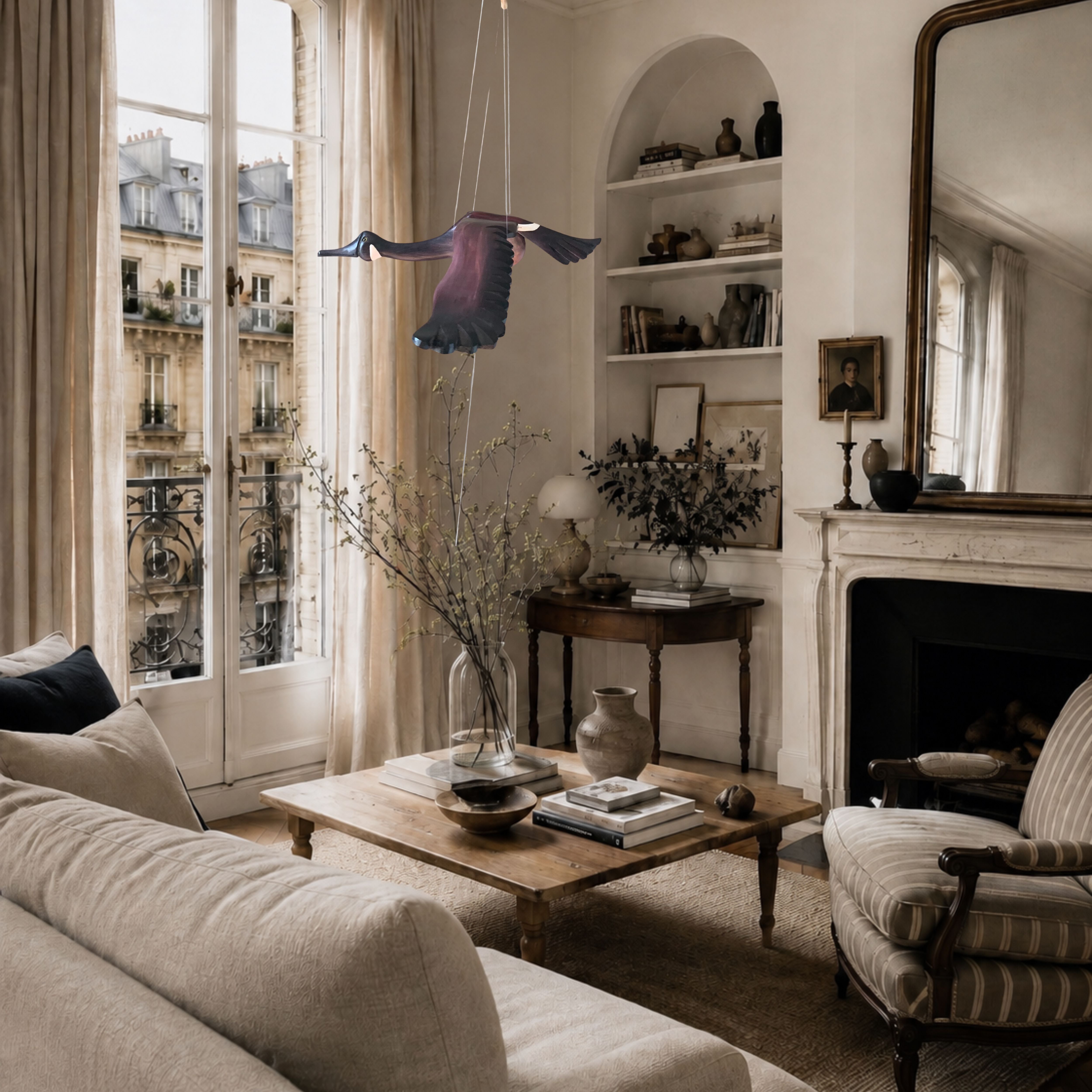
Suspended sculpture and kinetic art can occupy this otherwise unused space without requiring another piece of furniture, another picture or another styled surface.
This can work particularly beautifully in a bedroom, reading corner or quiet living space where the aim is to add interest without adding visual clutter.
Sculptural form, shadow and movement
Perhaps one of the most overlooked tools in a neutral interior is the relationship between an object's form and the shadow it casts.
A three-dimensional object offers something a flat surface cannot: a silhouette that changes as you move around it, shadows that alter throughout the day and a sense of physical presence within the room.
Introduce gentle movement and that effect becomes even more interesting.
A curtain shifting beside an open window, the shadows of branches moving across a wall, or a suspended object responding almost imperceptibly to the air can make a room feel alive.
Movement is particularly effective in a neutral interior because it creates interest without introducing anything new to the colour palette.
Our WoodWings Snowy Owl is a lovely example.
Hand-carved and hand-painted in our Johannesburg workshop, the owl is predominantly soft white with delicate feather markings. Rather than disrupting a pale interior with strong colour, its presence comes from its wingspan, carving, silhouette, shadow and movement.
Suspended from above, its wings can be raised and lowered, allowing the shape of the sculpture itself to change.
In a pale bedroom or Scandinavian-inspired interior, it reads less as an ornament and more as a piece of kinetic sculpture caught momentarily in flight.
Why a pale object doesn't disappear in a pale room
It might seem counterintuitive to place a predominantly white sculpture against an ivory, cream or pale grey background.
Surely it will simply disappear?
Not if it has enough form.
A three-dimensional object doesn't depend entirely on colour contrast to be seen. Its curves, edges and carved surfaces catch light differently, producing highlights and shadows that define its shape.
In fact, limiting colour can make those qualities more noticeable.
Instead of noticing colour first, you begin to notice craftsmanship, silhouette, texture and the changing relationship between the object and the light around it.
Use side light to reveal texture and carving
Light becomes particularly important in a restrained interior.
Diffuse overhead lighting tends to flatten surfaces because everything is illuminated from roughly the same direction.
Side light behaves very differently.
Light arriving through a window from one side creates tiny shadows across linen, timber grain, plaster, ceramic surfaces and carved details. It reveals texture that might otherwise barely be noticed.
This is why a sculptural or handmade object can look particularly beautiful positioned where morning or afternoon light reaches it from the side.
Individual carved feathers become more visible. Curves gain depth. Shadows change as the day progresses.
And the object can appear slightly different every time you walk into the room.
Allow negative space to be part of the design
Not every wall, shelf and surface needs filling.
Empty space isn't wasted space.
It gives the eye somewhere to rest and allows the things you have deliberately chosen to be properly seen.
One beautiful vessel can have more presence than five smaller objects clustered around it. One branch can be more striking than an elaborate arrangement. One sculptural piece suspended in otherwise empty space can become the thing you remember about the entire room.
Restraint gives objects importance.

Choose things with character
Perhaps the biggest misconception about neutral interiors is that everything within them must also be understated.
It doesn't.
A room can be quiet and still contain something extraordinary.
In fact, when colour is restrained, craftsmanship becomes more noticeable. Texture matters more. Shape becomes more expressive. Small variations and imperfections become part of the beauty of the object.
Handmade pieces work particularly well for this reason.
Each WoodWings bird is carved and painted individually, so no two are absolutely identical. With the Snowy Owl, there is very little bright colour competing for attention.
Instead, you notice the carved feathers, the markings, the wings, the silhouette and the movement.
Quiet doesn't have to mean plain
A successful neutral room isn't interesting despite its lack of colour.
It is interesting because other things have been allowed to become important.
Texture becomes richer. Shadows become visible. Natural materials feel warmer. Shape becomes more expressive. Movement becomes noticeable.
So before adding another coloured cushion or painting a feature wall, look again at what the room might actually be missing.
Perhaps it needs something rough beside something smooth.
Something curved beside something straight.
Something handmade beside something perfect.
Or perhaps it simply needs one beautiful thing, moving quietly in the light.