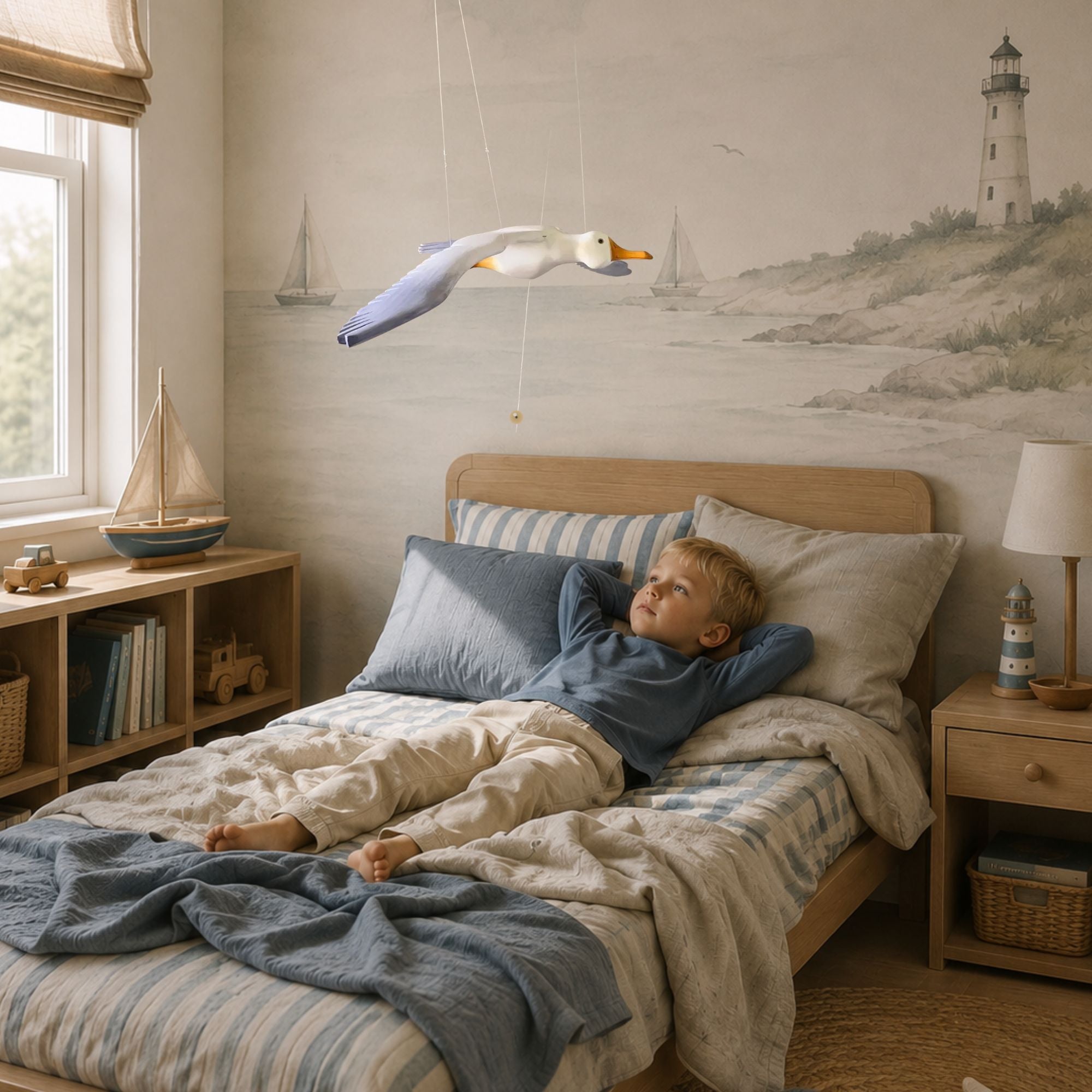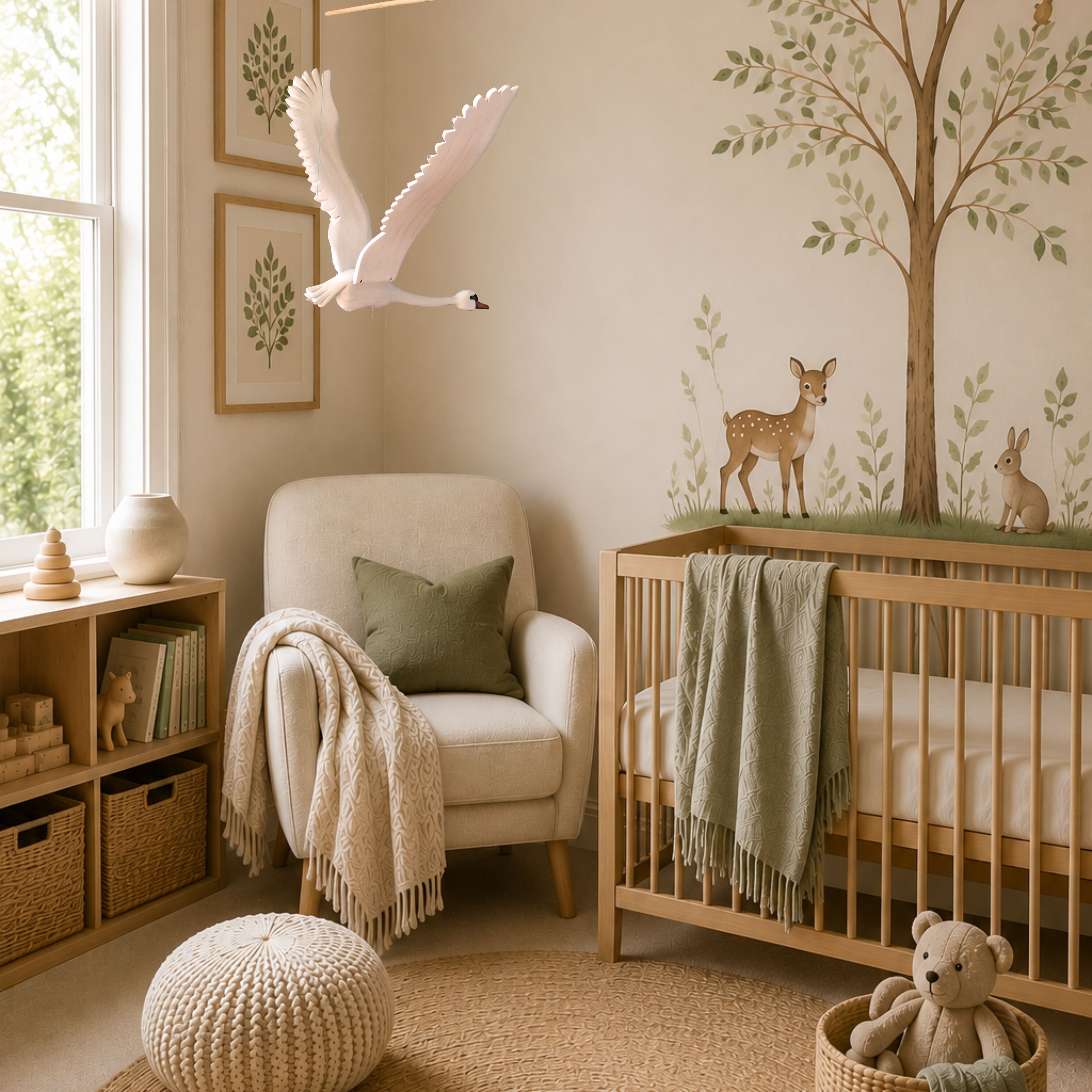
It’s Okay to Let Children Be Bored
 The Natural Pull of Movement
Long before children understand much about the world, they seem to understand animals. They watch dogs wagging their tails with the kind of attention adults reserve for important news. They follow ducks paddling across a pond. They stop dead on a walk because a butterfly has landed nearby, and nothing else matters until it leaves again.
Nobody teaches a child to do this. It just happens. There is something about a living creature in motion that draws a child's eye and holds it there, sometimes for far longer than we expect.
We have spent years carving birds by hand, and if there is one thing we have learned from watching how children respond to them, it is this: that same fascination doesn't need much to be sparked. It doesn't need noise or lights or anything happening quickly. It just needs something gentle to look at, and the time to look at it.
On Boredom and the Space It Leaves Behind
I have four children, and if there's one thing I've learned over the years, it's that the world they're growing up in is very different from the one I grew up in. Screens, noise, endless entertainment, content that never really stops. As a parent, there's a quiet pressure to keep them occupied, to make sure they're never bored, never under-stimulated, never just... sitting there with nothing to do.
A long time ago, I read something that stuck with me. The idea was simple: children don't need to be protected from boredom at all costs. At the time it felt almost counterintuitive, but the more I watched my own children grow, the more it made sense.
Some of the most absorbed, most imaginative moments I've seen weren't the ones we'd planned or filled with activity. They were the quiet in-between moments. Lying on the grass watching clouds. Crouched over an ant for ten minutes. Staring out of a car window at nothing in particular.
Those moments don't look like much from the outside. But something is happening in them. Boredom, it turns out, isn't always something to fix. Often it's just space, and children are remarkably good at filling that space themselves, with curiosity, with noticing, with wonder, if we let them.
The Toucan Story
We've been sent a lot of customer videos over the years, and so many of them are lovely, the kind of thing that makes our day. But one in particular has stayed with us in a way the others haven't.
It was sent by a mother whose son had just received our toucan mobile. In her review, she wrote that they'd ordered it for him, and that he was just one week old, but already in love with it.
The video itself is short. A tiny baby is holding onto the side of his cot, completely captivated by the toucan above him. He watches every movement with total concentration. It is one of those moments that reminds you how naturally children are drawn to animals, movement and the simple act of watching something unfold before them.
It’s one of those videos that we have never quite forgotten.
What strikes us most is that nothing dramatic is happening in the video. There are no flashing lights, sounds or screens competing for his attention. It's simply a baby and a bird. Yet somehow that was enough. In a world where so much is designed to grab attention, there is something reassuring about seeing a child so completely absorbed by something so simple.
More Than Something to Watch
It's worth saying that the birds aren't only something to look at from a distance. They can be reached for, pulled, and set in motion.
A lot of children discover this part for themselves. A small tug on the string, and suddenly it is in motion, coming alive before gradually settling again. There's a particular kind of delight in that, watching something you've just set off settle back into its quiet turning again, knowing you were the one who started it.
So the birds work both ways. They can be quietly observed, turning gently as the light shifts or a door opens somewhere in the house. Or they can be played with, sent into motion and watched as they slow back down. Often it ends up being both, sometimes within the same five minutes.
 It Doesn't End With Childhood
This fascination doesn't really switch off as we get older, either. At exhibitions and markets, we've watched adults stop beneath the birds and stay a little longer than they meant to. And we often hear about grandparents and older relatives who have one in their home and seem to genuinely enjoy having it there.
A Closing Thought
Maybe that's why children are so often drawn to birds. Not because they're complicated, but because they invite something that's becoming increasingly rare: the chance to pause, notice, and wonder for a while.
And perhaps that's something worth holding on to, no matter how old we are.