How to Create a Little Boy's Room That Grows With Him

There is a particular trap that's easy to fall into when decorating a little boy's room, and it usually starts with good intentions.
A theme feels like a shortcut to warmth. Dinosaurs, trucks, space rockets, jungle animals — something bold and specific that says, unmistakably, this is a little boy's room. And there is nothing wrong with any of those things in themselves. But a room built entirely around one idea tends to have a short life. What feels charming at two can feel faintly babyish by six, and by ten it often needs to be undone almost entirely and started again.
The alternative isn't a blank, neutral space with nothing in it. It's a room built with a little more patience — one where the furniture, the materials and the overall feeling are chosen to last, while the details around the edges are left open for him to fill in himself, as his own interests start to take shape.
Start with what will last
The furniture and larger decor decisions are the place to think furthest ahead, simply because they're the most expensive and the most disruptive to change later.
A well-made bed, a sturdy shelf, a desk that can go from holding building blocks to homework — these are worth choosing for their form and quality rather than for a print or motif that will read as very young in a few years' time. Neutral boy nurseries tend to age particularly well for exactly this reason: a soft, warm palette of whites, woods, blues or greens gives a room somewhere to grow, rather than boxing it into a single moment in his life.
This doesn't mean the room needs to feel restrained or unfinished. Texture does a lot of the work that pattern is often asked to do — a wool rug, a textured throw, a wooden lamp base, a linen blind. These things add warmth and personality without pinning the room to a particular age.
Leave room for his own collections
One of the more overlooked parts of decorating a child's room is deciding, quite deliberately, what not to finish.
A shelf left half empty. A pinboard with nothing on it yet. A stretch of wall that hasn't been assigned a purpose. These gaps matter, because a boy's room should have space to absorb whatever he becomes interested in next — the rock collection, the football posters, the model planes, the drawings he's proud of. A room that has been perfectly styled and photographed on day one often has nowhere left for him to leave his own mark on it.
Good kids' bedroom ideas tend to hold this balance well: enough structure to feel calm and considered, enough emptiness to feel like his.
Create a feeling, not a theme
This is really the heart of the whole approach, and it's easiest to explain with an example.
Say you're drawn to a nautical or coastal-feeling room. The obvious route is to fill it with anchors, boats and stripes until every surface is making the same point. The quieter route — and the one that tends to age far better — is to build the feeling of the sea into the room, rather than the imagery of it. Washed blues on a wall or a cushion. Natural wood furniture with a slightly weathered finish. A single well-made model boat on a shelf, rather than six. A framed map. A rope-handled basket for storing toys. The room evokes the coast without ever needing to say it outright, and a boy who has moved on from boats by eight will still feel at home in it.
The same principle works for almost any theme a family gravitates towards. A nature-inspired nursery doesn't need branches painted on every wall — a few well-chosen natural materials, an animal print or two, a woodland-toned palette, and a handful of meaningful objects will usually say more than an entire room committed to foxes and ferns. Restraint, in this sense, isn't about holding back on personality. It's about choosing the details that carry the feeling, rather than trying to make every single object do the same job.
Somewhere for reading, daydreaming and quiet time
Every children's room benefits from at least one corner that isn't built for activity at all.
It doesn't need to be large — a comfortable chair, a cushion on the floor, a low shelf of books within reach is usually enough. What matters is that it's a place where nothing is expected of him. Not tidying, not playing a particular way, not even necessarily reading, if he'd rather just sit there and think. Boys, in particular, are sometimes assumed to need constant activity, when in reality a quiet corner to retreat into can matter just as much as anywhere else in the room.
Natural materials and handmade objects
A room made almost entirely from natural materials — wood, wool, linen, stone, cotton — tends to feel calmer and more timeless than one built from bright plastic and printed motifs, and it also tends to suit a much wider age range without needing to be redone.
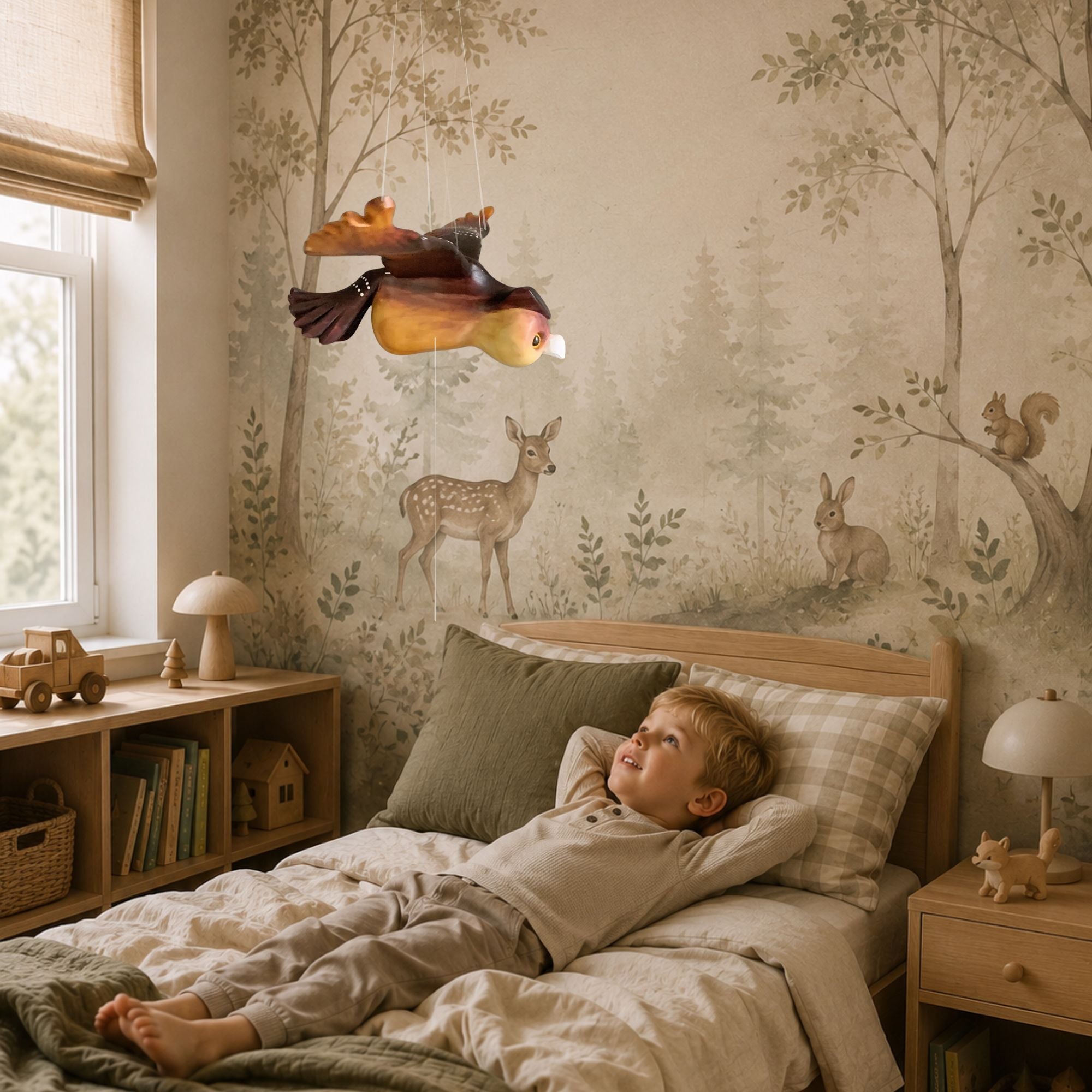
Handmade objects earn their place here too, partly because they carry a little more character than something mass-produced, and partly because they simply don't read as "for babies" or "for teenagers" in the way a themed print often does. A hand-carved wooden bird is a good example. Above a cot, one of our WoodWings birds looks entirely at home turning gently in the nursery air. But it doesn't stop belonging there once the cot is gone — the same bird can hang just as naturally above a reading corner or a desk in an older boy's room, because it was never trying to look like a piece of nursery decor in the first place. It's simply a beautiful, slightly wild-looking object that happens to suit a child's room particularly well, at almost any age.
That's really the test worth applying to anything you're considering bringing into the room: will this still feel right when he's ten, not just now, while he's small enough not to have an opinion about it yet.
Don't forget the space above the bed
It's easy to spend most of a room's budget and attention on the walls at eye level and forget entirely about the space above him — the ceiling, the area over the bed, the air in the middle of the room.
That space matters more than it's usually given credit for. A single object suspended overhead, whether it's a mobile, a light fixture with real character, or simply an interesting shape hung from the ceiling, gives a room a sense of depth that flat wall decor can't quite achieve on its own. It's often the first thing a child notices lying in bed, and the last thing he sees before falling asleep, which is a reasonable argument for choosing it with a bit more care.
Let the room evolve
Perhaps the most useful shift in mindset is simply accepting that the room isn't meant to be finished.
A boy's room, done well, is never really complete — it's added to, adjusted, and gradually rearranged as he grows and his own tastes start to assert themselves. The football scarf goes up. The dinosaur models come down, eventually, and something else takes their place. A poster is swapped for another. This isn't a failure of the original design; it's the design working as intended. A room built to be perfectly finished on day one is a room built to be replaced. A room built with room to grow simply keeps becoming more his, year after year, without ever needing to be undone.
That, in the end, is probably the real goal — not a boy nursery frozen in a single photograph, but a room that quietly keeps up with him, changing shape at roughly the same pace he does.